blueprint_ephemeris_lib🔭 Library blueprint_ephemeris_lib
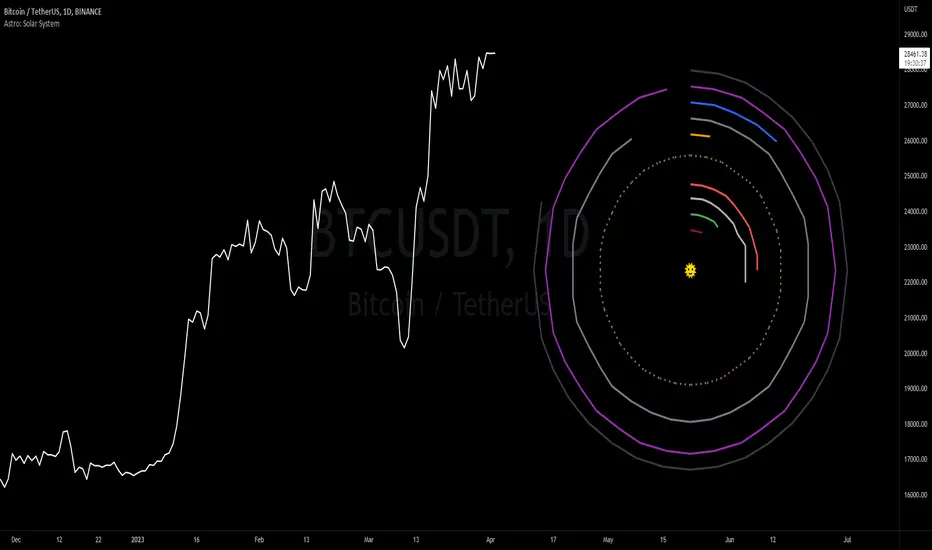
Consolidated planetary ephemeris library with improved accuracy. Supersedes previous individual planet libraries (lib_vsop_core, lib_vsop_mercury, lib_vsop_venus, etc.). One import gives you geocentric/heliocentric positions for all 10 solar system bodies.
█ ACCURACY — VALIDATED AGAINST JPL DE440
Every planetary body was validated against NASA's DE440 ephemeris (via Skyfield). Using only 1.6% of the full VSOP87D theory (511 of 31,577 terms), this library achieves sub-arcminute accuracy for all planets:
Sun 0.004° (14 arcseconds)
Mercury 0.005° (18")
Venus 0.006° (22")
Mars 0.010° (36")
Jupiter 0.007° (25")
Saturn 0.009° (32")
Uranus 0.013° (47")
Neptune 0.017° (61")
Moon 0.062° (3.7')
Pluto 0.059° (3.5')
All bodies under 0.1° RMS — more than sufficient for aspect calculations, ingress timing, and planetary line work. The Sun is accurate to 14 arcseconds using a truncated series that fits entirely inside Pine Script's token limits.
█ WHAT'S NEW (V2)
The original ephemeris required 11 chained library imports. A full validation audit uncovered critical coefficient errors and motivated this rewrite:
• L1 Precession Fix — All 8 VSOP87 planets had incorrect longitude rate coefficients (VSOP87B values instead of VSOP87D). Each was missing +0.24382 rad/millennium of general precession. This single correction reduced error from ~0.75° to < 0.1° across the board.
• 28% Smaller — 4,300 lines across 11 files → ~3,100 lines in 1 file.
• Single Import — No dependency chain. Faster execution.
• Moon Improvements — Functions accept raw `time` directly. Node functions renamed with explicit north/south designation.
█ THEORIES
VSOP87D (Bretagnon & Francou, 1988) — Mercury through Neptune
511 truncated terms out of 31,577 total (1.6%). Heliocentric spherical
coordinates in the ecliptic of date.
ELP2000-82 (Chapront-Touzé & Chapront, 1983) — Moon
91 terms (48 longitude + 43 latitude) from Meeus Chapter 47.
Meeus Series (Meeus, 1998) — Pluto
Analytical series from "Astronomical Algorithms" Ch. 37.
Valid ±1 century from J2000.
█ HOW TO USE
Import the library:
import BlueprintResearch/blueprint_ephemeris_lib/1 as eph
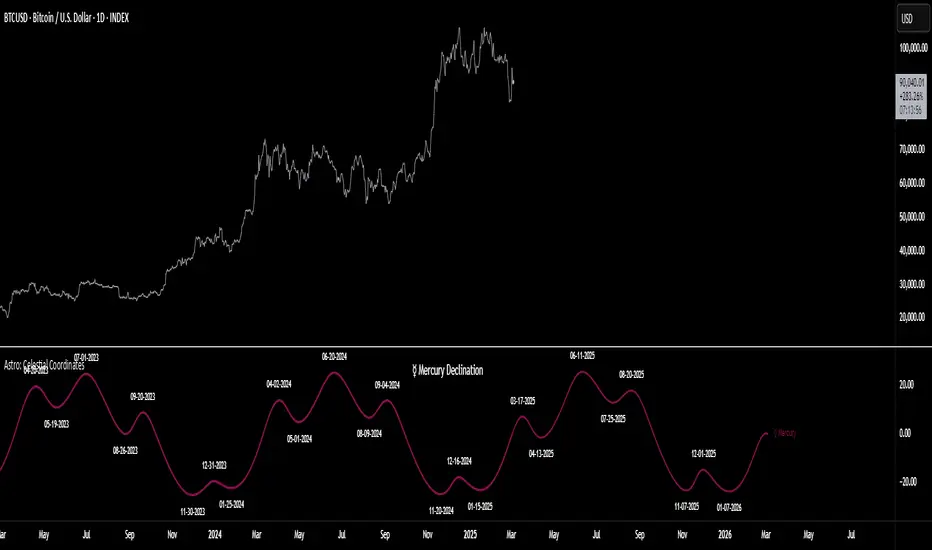
Basic — plot a planet's geocentric longitude and declination:
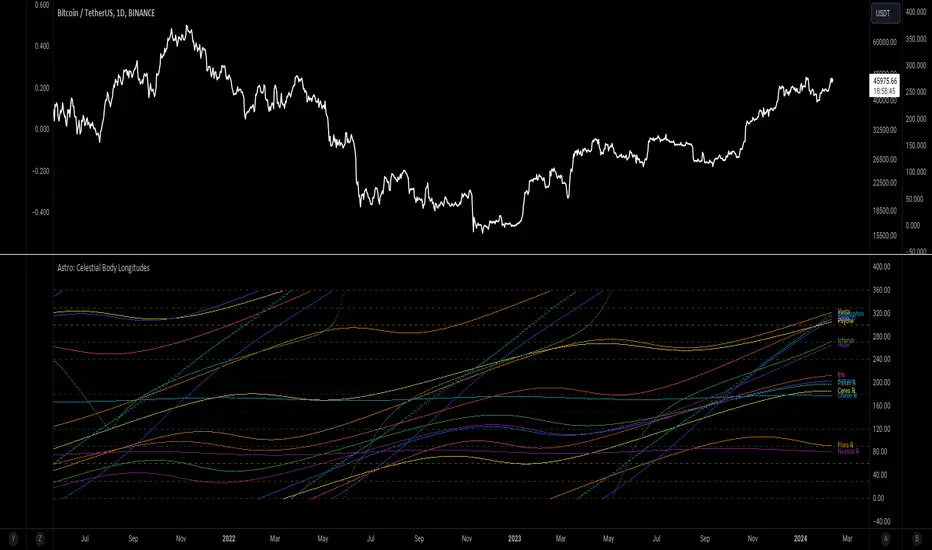
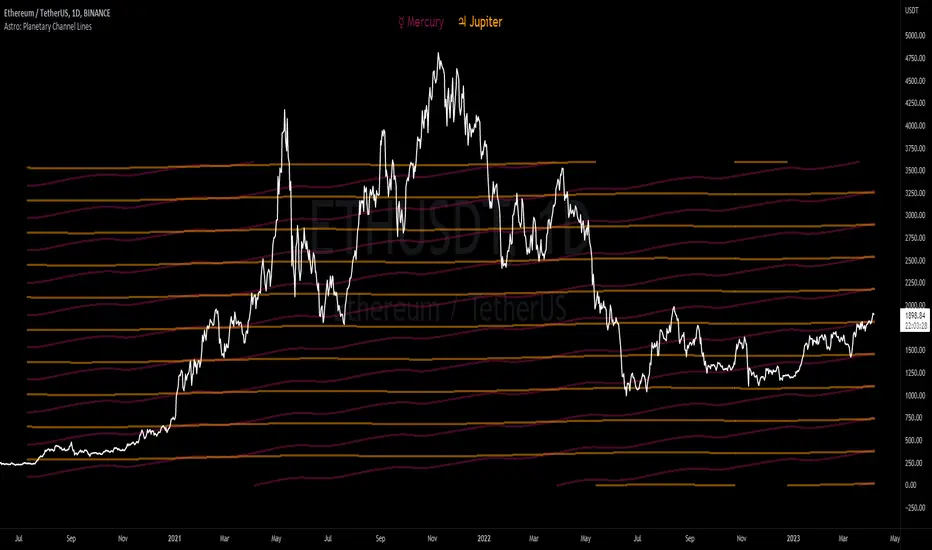
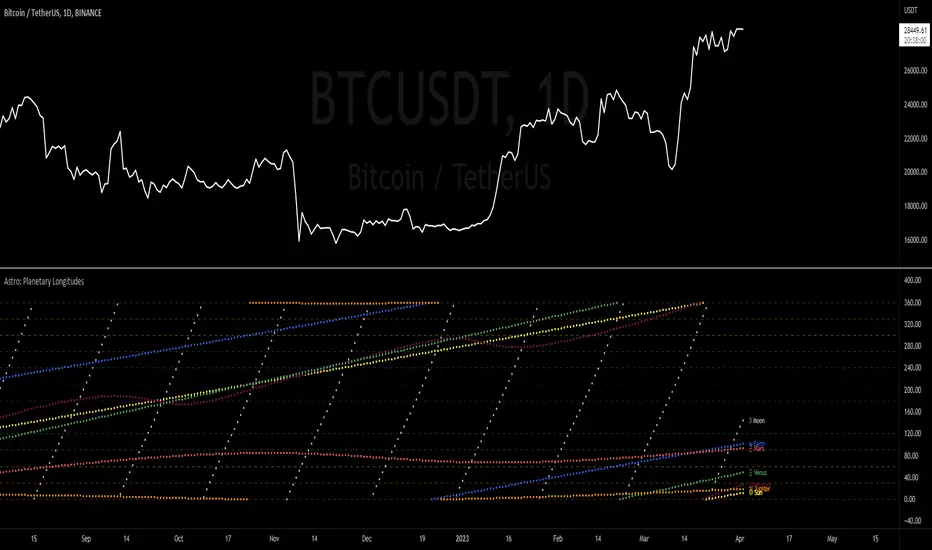
float jupiter_lon = eph.get_longitude(eph.Planet.Jupiter, time, true)
float jupiter_decl = eph.get_declination(eph.Planet.Jupiter, time)
plot(jupiter_lon, "Jupiter Geo Lon", color.yellow)
plot(jupiter_decl, "Jupiter Decl", color.red)
Retrograde detection:
bool mercury_retro = eph.is_retrograde(eph.Planet.Mercury, time)
bgcolor(mercury_retro ? color.new(color.red, 90) : na)
Moon nodes and declination:
float north_node = eph.get_mean_north_node_lon(time)
float south_node = eph.get_mean_south_node_lon(time)
float moon_decl = eph.get_declination(time)
plot(north_node, "North Node", color.green)
plot(south_node, "South Node", color.purple)
plot(moon_decl, "Moon Declination", color.orange)
Dynamic planet selection from input:
string planet_str = input.string("Sun", "Planet", options= )
eph.Planet p = eph.string_to_planet(planet_str)
float geo = eph.get_longitude(p, time, true)
float helio = eph.get_longitude(p, time, false)
float speed = eph.get_speed(p, time)
plot(geo, "Geocentric", color.yellow)
plot(helio, "Heliocentric", color.blue)
plot(speed * 100, "Speed x100", color.white)
All functions accept TradingView's `time` variable directly.
█ FUNCTIONS
Unified API (all planets):
`get_longitude(Planet, time, preferGeo)` — geo or heliocentric longitude
`get_declination(Planet, time)` — equatorial declination
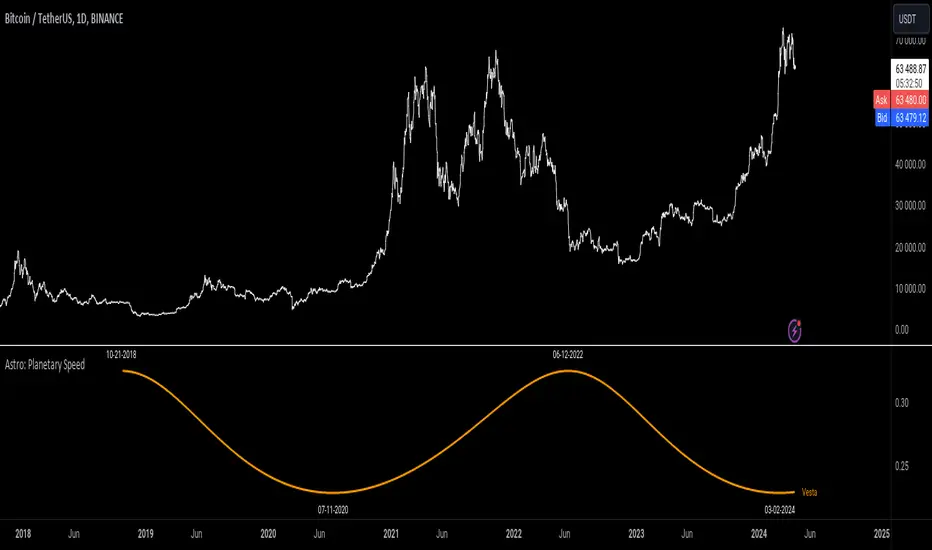
`get_speed(Planet, time)` — longitude speed (°/day)
`is_retrograde(Planet, time)` — true when retrograde
`string_to_planet(string)` — name to enum
Averages :
`get_avg6_geo_lon` / `get_avg6_helio_lon` — Mercury–Saturn
`get_avg8_geo_lon` / `get_avg8_helio_lon` — Mercury–Neptune
Moon (direct access):
`get_geo_ecl_lon(time)` · `get_geo_ecl_lat(time)` · `get_declination(time)`
`get_mean_north_node_lon(time)` · `get_mean_south_node_lon(time)`
`get_true_north_node_lon(time)` · `get_true_south_node_lon(time)`
`get_north_node_declination(time)` · `get_south_node_declination(time)`
█ LIMITATIONS
• Truncated series — sub-degree accuracy, not sub-arcsecond. More than sufficient for ingress timing and aspect work.
• Validated against DE440 across 250 years (1850–2100). Over this full span, the worst-case VSOP87 planet (Uranus) is 0.017° RMS / 0.043° max error. Ingress dates manually verified back to the late 1800s with consistent accuracy.
• Pluto uses Meeus series, limited to ±1 century from J2000.
• Moon has no speed function.
█ ACKNOWLEDGMENTS
Coefficient validation was made possible by Greg Miller's VSOP87 multi-language project, which provides the complete VSOP87D coefficient tables in accessible formats. His work converting the original Fortran data files into CSV/JSON for multiple languages was essential for identifying the L1 precession errors in the original libraries. Miller released this work into the public domain.
github.com/gmiller123456/vsop87-multilang
References :
• Meeus, Jean. Astronomical Algorithms (2nd Ed., 1998)
• Bretagnon & Francou. VSOP87 Solutions (Astronomy & Astrophysics, 1988)
• Chapront-Touzé & Chapront. ELP2000-82 (1983)
█ OPEN SOURCE
MIT License — part of the Blueprint Research open-source toolkit.
Source code on GitHub
get_geo_ecl_lon(time_)
Returns geocentric ecliptic longitude of the Moon.
Parameters:
time_ (float)
Returns: (float) Longitude in degrees, range [0, 360).
get_geo_ecl_lat(time_)
Returns geocentric ecliptic latitude of the Moon.
Parameters:
time_ (float)
Returns: (float) Latitude in degrees.
get_obliquity_j(time_)
Returns mean obliquity of the ecliptic.
Parameters:
time_ (float)
Returns: (float) Obliquity in degrees.
get_declination(time_)
Returns geocentric equatorial declination of the Moon.
Parameters:
time_ (float)
Returns: (float) Declination in degrees, range where positive is north.
get_declination(p, t)
Returns planetary geocentric equatorial declination.
Parameters:
p (series Planet) : (Planet) Planet to query.
t (float) : (float) Unix timestamp in milliseconds (use built-in 'time' variable).
Returns: (float) Geocentric declination in degrees, range where positive is north.
@note Declination is always geocentric (no heliocentric equivalent in library).
get_mean_north_node_lon(time_)
Returns mean longitude of the Moon's North Node (ascending node).
Parameters:
time_ (float)
Returns: (float) Longitude in degrees, range [0, 360).
@note Mean node is a simple averaged calculation, reducing computational error. Used for declination calculations.
get_mean_south_node_lon(time_)
Returns mean longitude of the Moon's South Node (descending node).
Parameters:
time_ (float)
Returns: (float) Longitude in degrees, range [0, 360). Equals North Node + 180°.
get_true_north_node_lon(time_)
Returns true longitude of the Moon's North Node with perturbation corrections.
Parameters:
time_ (float)
Returns: (float) Longitude in degrees, range [0, 360).
@note True node includes periodic perturbations but formula is low precision. Consider using mean node for consistency.
get_true_south_node_lon(time_)
Returns true longitude of the Moon's South Node with perturbation corrections.
Parameters:
time_ (float)
Returns: (float) Longitude in degrees, range [0, 360). Equals True North Node + 180°.
get_north_node_declination(time_)
Returns declination of the Moon's North Node.
Parameters:
time_ (float)
Returns: (float) Declination in degrees, range (bounded by obliquity).
@note Uses mean node for calculation (more consistent than true node).
get_south_node_declination(time_)
Returns declination of the Moon's South Node.
Parameters:
time_ (float)
Returns: (float) Declination in degrees. Inverse of North Node declination.
normalizeLongitude(lon)
Normalizes any longitude value to the range [0, 360) degrees.
Parameters:
lon (float) : (float) Longitude in degrees (can be any value, including negative or >360).
Returns: (float) Normalized longitude in range [0, 360).
string_to_planet(planetStr)
Converts a planet string identifier to Planet enum value.
Parameters:
planetStr (string) : (string) Planet name (case-insensitive). Supports formats: "Sun", "☉︎ Sun", "sun", "SUN"
Returns: (Planet) Corresponding Planet enum. Returns Planet.Sun if string not recognized.
@note Supported planet strings: Sun, Moon, Mercury, Venus, Earth, Mars, Jupiter, Saturn, Uranus, Neptune, Pluto
get_longitude(p, t, preferGeo)
Returns planetary longitude with automatic coordinate system selection.
Parameters:
p (series Planet) : (Planet) Planet to query.
t (float) : (float) Unix timestamp in milliseconds (use built-in 'time' variable).
preferGeo (bool) : (bool) If true, return geocentric; if false, return heliocentric.
Returns: (float) Longitude in degrees, normalized to range [0, 360).
@note Sun and Moon always return geocentric regardless of preference (heliocentric not applicable).
get_speed(p, t)
Returns planetary geocentric longitude speed (rate of change).
Parameters:
p (series Planet) : (Planet) Planet to query.
t (float) : (float) Unix timestamp in milliseconds (use built-in 'time' variable).
Returns: (float) Geocentric longitude speed in degrees per day. Negative values indicate retrograde motion. Returns na for Moon.
@note Speed is always geocentric (no heliocentric equivalent in library). Moon speed calculation not implemented.
get_avg6_geo_lon(t)
get_avg6_geo_lon
@description Returns the arithmetic average of the geocentric longitudes for the six outer planets: Mars, Jupiter, Saturn, Uranus, Neptune, and Pluto.
Parameters:
t (float) : (float) Time in Unix timestamp (milliseconds).
Returns: (float) Average geocentric longitude of the six outer planets in degrees, range [0, 360).
get_avg6_helio_lon(t)
get_avg6_helio_lon
@description Returns the arithmetic average of the heliocentric longitudes for the six outer planets: Mars, Jupiter, Saturn, Uranus, Neptune, and Pluto.
Parameters:
t (float) : (float) Time in Unix timestamp (milliseconds).
Returns: (float) Average heliocentric longitude of the six outer planets in degrees, range [0, 360).
get_avg8_geo_lon(t)
get_avg8_geo_lon
@description Returns the arithmetic average of the geocentric longitudes for all eight classical planets: Mercury, Venus, Mars, Jupiter, Saturn, Uranus, Neptune, and Pluto.
Parameters:
t (float) : (float) Time in Unix timestamp (milliseconds).
Returns: (float) Average geocentric longitude of all eight classical planets in degrees, range [0, 360).
get_avg8_helio_lon(t)
get_avg8_helio_lon
@description Returns the arithmetic average of the heliocentric longitudes for all eight classical planets: Mercury, Venus, Mars, Jupiter, Saturn, Uranus, Neptune, and Pluto.
Parameters:
t (float) : (float) Time in Unix timestamp (milliseconds).
Returns: (float) Average heliocentric longitude of all eight classical planets in degrees, range [0, 360).
is_retrograde(p, t)
Returns true if the planet is currently in retrograde motion (geocentric speed < 0) == 0 = stationary.
Parameters:
p (series Planet) : The planet to check.
t (float) : Time in Unix timestamp (milliseconds).
Returns: true if the planet is in retrograde, false otherwise.
ספריית Pine Script®