US & EU Banking Basket Analysis (Dual Sentiment + Forecast) betaThis is “THE BANKING DECISION ENGINE”.
Some say "'Banks lead the way'"
(As always use in combination with other trading instruments and market awareness information).
US & EU Banking Basket Analysis (Dual Sentiment + Forecast)
One indicator for the big banking sector! – both sides of the Atlantic
– just add to your chart.
WHAT IT DOES
• Pulls live data from 14 major US and EU banks (JPM, BAC, GS, HSBC, Santander, Deutsche Bank, ING, Barclays etc.)
• Instantly compares strength/weakness between American and European banking sectors
• Shows you TWO separate real-time sentiment lines on your chart: • Blue/Purple line = US banking sentiment • Green/Red line = European banking sentiment
• Combines moving-average momentum, volume + RSI confirmation, major indices (DJI, SPX, NASDAQ, DAX), DXY direction, and ultra-fast 1-second “Volatility Pulse” technology
• Gives you forward-looking tools so you’re not just reacting:
→ Statistical price prediction cloud (looks back 200 bars for similar sentiment situations and shows the average outcome) → Purple prediction bar + exact target price (shows where price is expected to be N bars ahead) → 15-minute “Pulse Forecast” dotted line (second-beat momentum projection) → Optional EUR/USD forecast line when on EUR/USD chart (because currency moves the banks hard)
──────────────────────── VISUAL ENHANCEMENTS YOU GET
• Clean split sentiment lines that never overlap (zoom-proof)
• Glowing fill + permanent “US” / “EU” tags
• Tiny bar labels (EUs / USm etc.) showing exactly how many banks are firing buy/sell right now
• Full banking watchlist table (top-right) with live prices, % change and instant signals
• Major index ticker (DJI, SPX, NASDAQ, DAX) with exploding alerts
• Supply/demand zones, previous daily range, high-volume “V” signals and more
──────────────────────── PERFECT FOR
• Trading any bank stock (US or EU)
• Trading XLF, KBE, EUFN or banking ETFs
• Trading EUR/USD while watching how the banking sector reacts
• Scalping, intraday, swing – works from 1-minute up to daily
One indicator. Both continents. Zero clutter. Maximum edge.
(Works on any chart: apply it to JPM, SAN, EURUSD, SPX… it auto-detects the region and adjusts)
Ready when you are. Let’s go banking. 🚀 “Carefully and responsibly of course”.
Quick Guide to What You’re Seeing on the Chart
Dual Sentiment Lines (the two thick glowing lines in the middle of the screen)
• Upper line (Blue → Purple → Orange) → US banking sector sentiment
• Bright purple = strong US bullish
• Light blue-purple = moderate/mild US bullish
• Orange = bearish US sentiment
• Lower line (Green → Lime → Red) → European banking sector sentiment
• Lime/green = strong EU bullish
• Darker green = moderate EU bullish
• Red = bearish EU sentiment
These two lines are deliberately split vertically so they never cross or confuse each other, no matter how much you zoom.
Tiny labels on the candles (EUs, USm, EUw, etc.)
• Show exactly how many banks in each region are flashing buy or sell right now
• “7 EUs” = all 7 European banks are strong buy
• “4 USm” = 4 US banks are medium-strength buy
• Appear only when the “Show Bar/Plot Labels” toggle is on
Purple vertical bar on the far right + label
• Your statistical price target (default 5 bars ahead)
• Box height = expected price move
• Label shows exact target price + % average historical move (or “Fallback” if using sentiment-based projection)
Faint cloud in front of the current price
• Prediction cloud showing the probable price zone in the next few bars
• Green cloud = historically price went up from similar sentiment
• Red cloud = historically price went down
Dotted horizontal line + target label
• Daily barometer – shows the exact same statistical target as the purple bar, just drawn as a line for cleaner view
White dotted line (15-minute Pulse Forecast)
• Ultra-short-term momentum projection (usually 10-30 min ahead) based on 1-second “pulse” data from all major indices
• Appears only when the pulse is strong enough
Top-right table
• Live watchlist of all 14 banks + instant signal summary
• Green/red dot = volume+RSI confirmation
• S Buy / M Buy / W Buy etc. = MA-based signal strength
Bottom-center index ticker
• Real-time % change of DJI, S&P 500, NASDAQ, DAX
• !!! / !! / ! = explosion alerts (bigger move = more exclamation marks)
Other helpful layers (toggle on/off in settings)
• Previous day’s high/low range (teal shaded area)
• Supply/demand zones (green/red boxes)
• High-volume “V” markers
• DXY (USD strength) arrows
Like a masterpiece. Not just another isolated chart indicator.
Final note: Trading instruments such as this consist of historical data behind the current seconds and minutes, therefore do not guarantee prediction, forecast profit results or guarantee protection from financial losses such as in whipsaw downturns in long positions or whipsaw market swings in short positions. This decision engine is intended for use in combination with user discretion.
Institutions

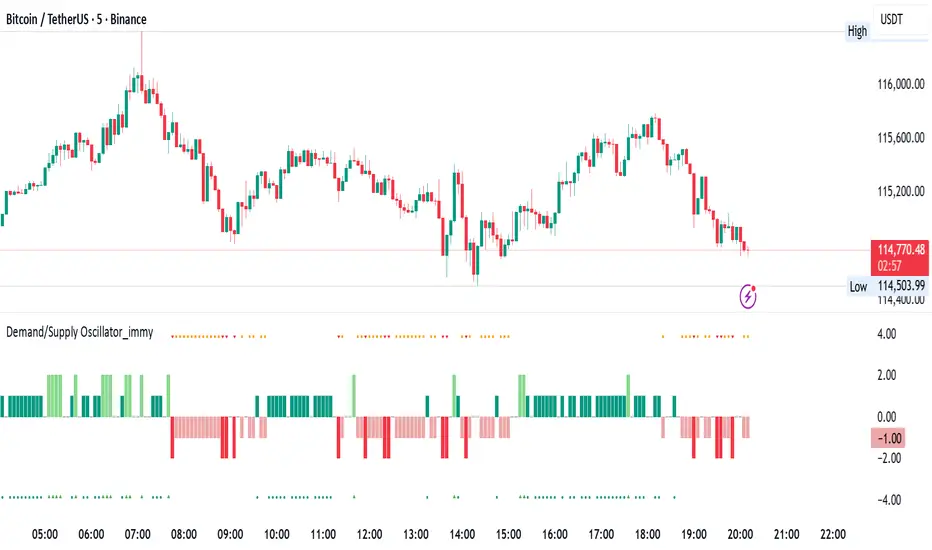
Demand/Supply Oscillator_immyDemand/Supply Oscillator, probably the only D/S oscillator on TV which doesn't draw the lines on the chart but to show you the actual reasons behind the price moves.
Concept Overview
A demand/supply oscillator would aim to look for the hidden spots/order which institutes place in small quantities to not to upset the trend and suddenly place one big order to liquidate the retailers and make a final big move.
The lite color candles in histogram shows the hidden demand/supply which is the reason behind the sudden price pullback, even for short period of time.
Measure demand and supply based on volume, price movement, or candle structure
Identify price waves or impulses (e.g., using fractals, zigzag, or swing high/low logic)
Detect hidden demand/supply (e.g., low volume pullbacks or absorption zones)
Plotted on histogram boxes to visualize strength and direction of each wave
What “Hidden Demand” Means?
Hidden demand refers to buying pressure that isn’t immediately obvious from price action — in other words, buyers are active “behind the scenes” even though the price doesn’t yet show strong upward movement.
What Hidden supply Means?
refers to selling pressure that isn’t obvious yet on the price chart. It means smart money (big players) are quietly selling or distributing positions, even though the price might not be dropping sharply yet.
It usually appears when:
The price is pulling back slightly (down candle),
But volume or an oscillator (like RSI, MACD, or OBV) shows bullish strength (e.g., higher low or positive divergence).
That suggests smart money is accumulating (buying quietly) while the public may think it’s just a normal dip.
💹 Price Reaction — Up or Down?
If there is hidden demand, it’s generally a bullish signal → meaning price is likely to go up afterward.
However, on that exact candle, the price may still be down or neutral, because:
Hidden demand is “hidden” — buyers are absorbing supply quietly.
The move up usually comes after the hidden demand signal, not necessarily on the same candle.
📊 Example
Suppose:
Price makes a slightly lower low,
But RSI makes a higher low → this is bullish (hidden) divergence, or “hidden demand.”
➡️ Interpretation:
Smart buyers are stepping in → next few candles likely move up.
The current candle might still be red or show a small body — that’s okay. The key is the shift in underlying strength.
🧭 Quick Summary
Term Meaning Candle Effect Expected Move After
Hidden Demand Buyers active below surface Candle may still go down or stay flat
Hidden Supply Sellers active behind the scenes Price likely to rise soon
🛠️ Key Components
Best results with Price/Action e.g. Use swing high/low or zigzag to segment price into waves.
Optionally apply fractal logic for more refined wave detection
Combine with other indicators (e.g., RSI, OBV) for confirmation
Include zone strength metrics (e.g., “Power Number” as seen in some indicators)
Demand/Supply Calculation
Demand: Strong bullish candles, increasing volume, breakout zones
Supply: Strong bearish candles, volume spikes on down moves
Hidden Demand/Supply: Pullbacks with low volume or absorption candles
Histogram Visualization
Use plot() or plotshape() to draw histogram bars
Color-code bars: e.g., green for demand, red for supply, lite colors for hidden zones
Add alerts for wave transitions or hidden zone detection
How It Works
Demand/Supply: Detected when price moves strongly with volume spikes.
Hidden Zones: Detected when price moves but volume is low (potential absorption).
Histogram Values:
+2: Strong Demand
+1: Hidden Demand
-1: Hidden Supply
-2: Strong Supply
0: Neutral
Feature Demand (Visible) Hidden Demand
Visibility Clearly seen on price charts Subtle, often masked in consolidation
Participants Retail + Institutional Primarily Institutional
Price Behavior Sharp rallies from zone Sideways movement, low volatility
Tools to Identify Candlestick patterns, support zones Volume profile, order flow, price clusters
Risk/Reward Moderate (widely known) High (less crowded, early entry potential)
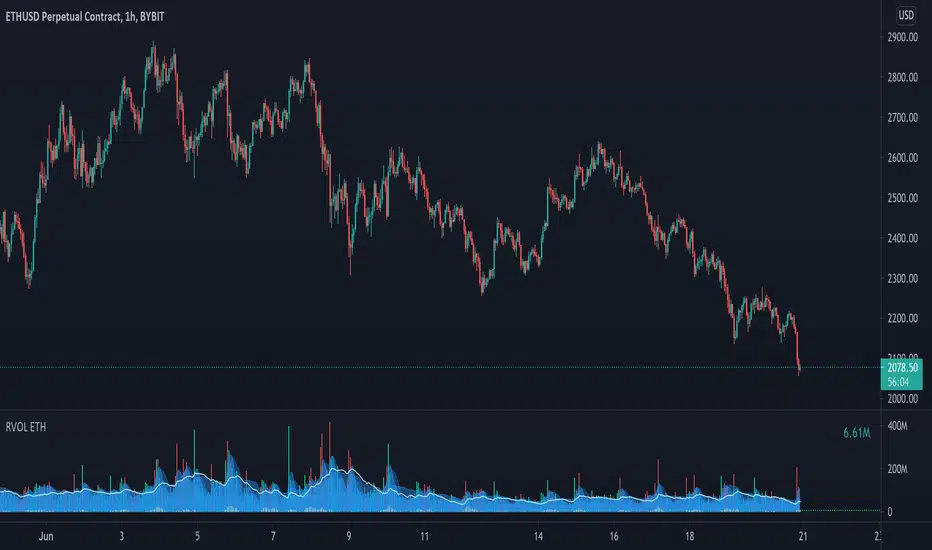
Relative Volume - ETHEREUMRelative Volume indicator that pulls data from 9 different Ethereum exchanges. Please note that this indicator only works with ETH and will not use data from your current chart.
Includes the following exchanges:
BYBIT:ETHUSD
BITFINEX:ETHUSD
BITSTAMP:ETHUSD
INDEX:ETHUSD
COINBASE:ETHUSD
FTX:ETHUSD
PHEMEX:ETHUSD
BITTREX:ETHUSD
POLONIEX:ETHUSDT
Relative Volume - BITCOINRelative Volume indicator that pulls data from 9 different Bitcoin exchanges. Please note that this indicator only works with BTC and will not use data from your current chart.
Includes the following exchanges:
BYBIT:BTCUSD
BITFINEX:BTCUSD
BITSTAMP:BTCUSD
INDEX:BTCUSD
COINBASE:BTCUSD
FTX:BTCUSD
PHEMEX:BTCUSD
BITTREX:BTCUSD
POLONIEX:BTCUSDT
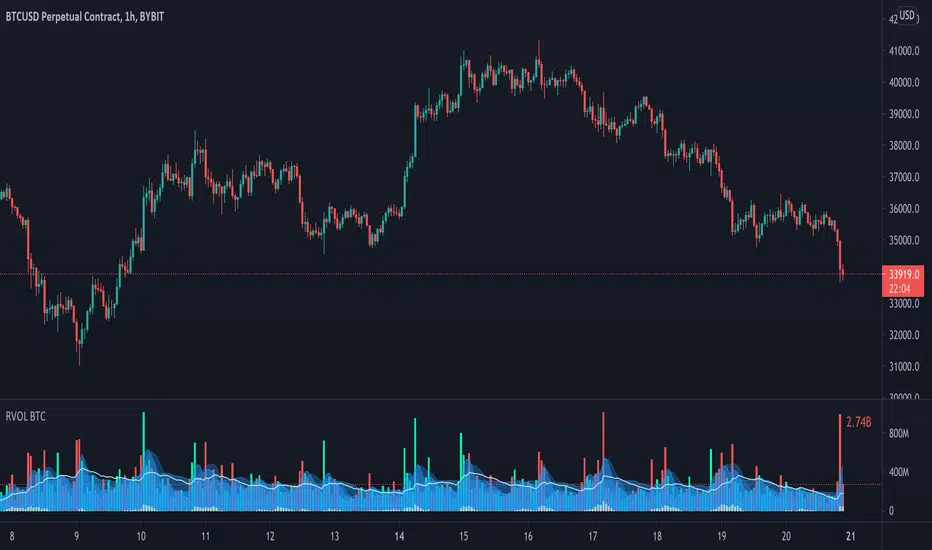
Relative VolumeVolume can be a very useful tool if used correctly. Relative volume is designed to filter out the noise and highlight anomalies assisting traders in tracking institutional movements. This tool can be used to identify stop loss hunters and organized dumps. It uses a variety of moving averages to hide usual activity and features an LSMA line to show trend. Trend columns are shown to highlight activity and can be seen at bottom of the volume columns, this is done using ZLSMA and LSMA.
The above chart shows an example of 2 indicators being used on the 15 min chart. The bottom indicator is set to the 1 min chart. Traders can see a large dump on the 1 min chart as institutions wipe out any tight stop losses. Next they buy back in scooping up all those long positions.
This is an example layout using a split screen setup and multiple timeframes ranging from 1 min to 30 mins. This gives a clear indication of trends and make it easy to pickup on institutional behaviour. Tip: Double clicking indicator background will maximize RVOL to the split screen window.

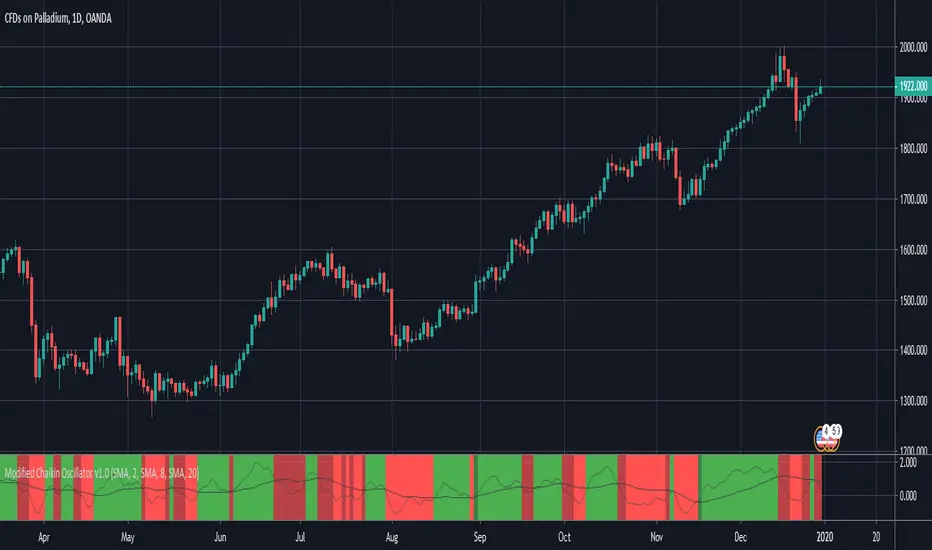
Modified Chaikin OscillatorThis is a modified version of the Chaikin Oscillator. The idea is to find accumulation and distribution phases in the market to identify when institutions are building their positions.
It uses acc/dist but as an oscillator, just like the Chaikin Oscillator, but not to find overbought or oversold areas, but to find trends. It functions like a MACD. It takes a fast moving average of the acc/dist and a slow moving average of the acc/dist, and plots the differense to create the oscillator, and uses a signal line to use for entries.
A strong signal is when the oscillator crosses the signal line while the signal line is on he right side of 0. So a crossover (long) when the signal line is below 0 woul be a weak signal, while a crossover (long) when the signal line is above 0 would be a strong signal.
By default, tick volume is discarded in the calculation, which makes this version behave a bit differently than the standard Chaikin Oscillator. This is because the indicator is mostly used to trade CFD's. If used to trade stocks for example, it is better to include the volume by unchecking that checkbox in the indicator settings.
BRIGHT GREEN = Strong signal LONG (signal line is above 0)
DARK GREEN = Weak signal LONG (signal line is below 0)
BRIGHT RED = Strong signal SHORT (signal line is below 0)
DARK RED = Weak signal SHORT (signal line is above 0)